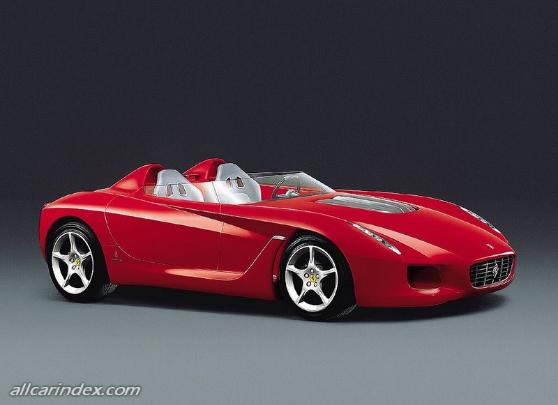



The Ferrari Mythos is a one-off concept car designed and built by Pininfarina, based on Ferrari mechanicals, and shown publicly at the end of the 1980s. Sergio Pininfarina confirmed that despite speculation to the contrary, the Mythos was a single example rather than a car intended for series production. It was conceived as a design study, a barchetta-style speedster without doors or windows, built to explore pure styling rather than to serve as a basis for a production model.
According to Pininfarina general director Lorenzo Ramaciotti, work on realizing the design began in early 1989. The goal was to create a particularly compact, highly sporting open car, and the Testarossa was chosen as its technical basis, retaining the Ferrari's longitudinally mounted flat 12-cylinder mid-engine layout. The Mythos kept the Testarossa's wheelbase unchanged but reduced overall length from 448.5 cm to 430.5 cm, achieved mainly by shortening the rear overhang by 64 cm. This shorter tail required a redesigned exhaust system, which altered the sound of the flat-12 engine compared with the standard Testarossa.
The bodywork was described by Ramaciotti as combining a boat-like form with a delta-shaped basic layout, with the flared front and the wide rear meeting at the level of the cockpit. A large lateral air intake served as a visual focal point where these flowing lines converged. Ornamentation was minimal, limited essentially to sculpted, star-patterned wheels. The car reflected Pininfarina's long design association with Ferrari and was built purely around the idea of driving enjoyment in its most direct form.
Despite its focus on styling, the Mythos incorporated several newly engineered functional details, including two movable aerodynamic devices. A lip beneath the front spoiler could extend by 3 cm to increase downforce, while a rear wing integrated into the tail could rise by 30 cm and simultaneously change its angle of attack by 12 degrees. Together these elements produced 150 kg of downforce at 250 km/h and cut lift by 50 percent. Both devices deployed automatically at 100 km/h and retracted once speed dropped below 70 km/h. With the spoiler lip and wing extended, the drag coefficient rose to 0.37, a value considered acceptable for a roofless car with side-mounted radiators despite refinement work carried out in Pininfarina's own wind tunnel; with the aerodynamic aids retracted, the drag coefficient was given as 0.35.
Inside, the two-seat cabin featured seat shells integrated into the frame, anatomically shaped and leather-covered. The redesigned three-spoke steering wheel and pedals were adjustable together for reach. Instrument displays were carried over from the Testarossa but housed in a newly styled dashboard, with control buttons grouped into satellite pods on either side of the steering wheel. The car rode on Pirelli Zero tires sized 245/40 at the front and 335/25 ZR 17 at the rear.
To advance the use of materials as well as styling, the Mythos body was built using composite materials chosen for their high rigidity. The Testarossa's tubular frame had to be reinforced to suit the open barchetta structure. The use of composites, following an approach already applied to the carbon/Kevlar body of the Ferrari F40, reduced weight by around 250 kg compared with the standard Testarossa, improving the power-to-weight ratio to 3.2 kg per horsepower.
Mechanically, the Mythos used the Testarossa's flat-12 engine, mounted longitudinally amidships, with a displacement of 4942 cc, double overhead camshafts, and 48 valves, producing 390 hp at 6300 rpm and 490 Nm of torque at 4500 rpm. The car measured 430.5 cm in length, 210 cm in width and 106.5 cm in height, with a wheelbase of 255 cm and track widths of 152 cm front and 173 cm rear. It weighed 1250 kg and had a top speed given as over 290 km/h.
The Mythos toured major motor shows including Tokyo, Detroit and Geneva. Before its public unveiling it had already been shown to the specialist press by Pininfarina at its own test track at Pininfarina Studi e Ricerche near Turin, where it completed a number of demonstration laps. Following its show circuit, the Mythos was made available for more extensive test drives in 1990. At the Tokyo Motor Show, the Japanese magaz